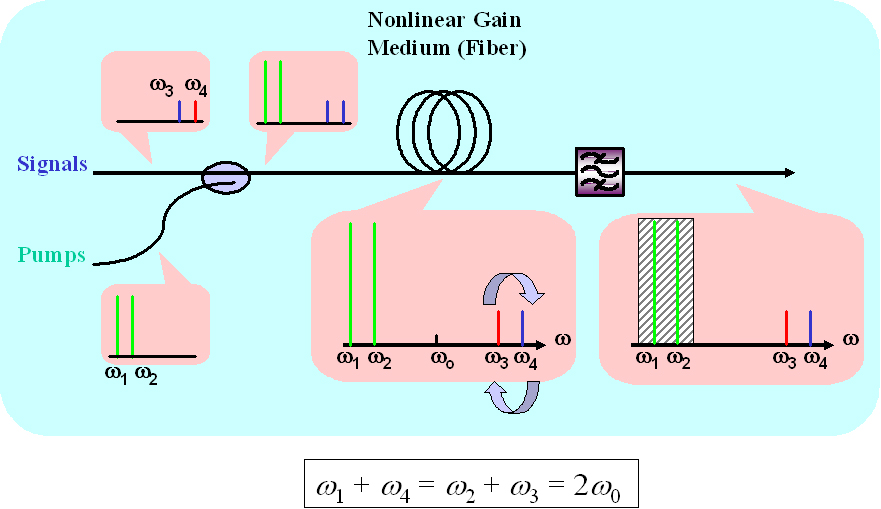
Much research has been done recently on developing fiber-based techniques for wavelength conversion. Most of the approaches used to date generate a new wave whose spectrum is a phase-conjugated version of that of the signal; the wave is obtained by symmetry about the zero-dispersion wavelength l0 and, therefore, exhibits spectral inversion. Recently, we showed that fiber optic parametric amplifiers can provide such broadband wavelength converters, with a signal bandwidth of the order of 400 nm. Such devices, however, are not tunable, in the sense that a given signal wavelength cannot be converted into an arbitrary new wavelength. We have theoretically shown that a different arrangement of two strong pumps, and two weak signals can provide a novel feature: specifically, complete exchange of power between the two signal wavelengths, without spectral inversion. It is what we called wavelength exchange (WE).
Previous effort included achieving simultaneous conversion of two signals by a suitable choice of wavelengths of two pumps at the normal dispersion region and the two signals at the anomalous region with respect to the zero-dispersion frequency ω0 of a fiber (denoted as WE I). Results show that the pump induced Raman amplification introduces asymmetric power transfer that degrades the performance of the WE I process. Such performance degradation is particularly severe when the two pumps are arranged orthogonally at the normal dispersion region. Recently, we propose another configuration (denoted as WE II) with two pumps at the anomalous dispersion region, where the performance degradation caused by Raman effect can be eliminated. With this arrangement, signals at the normal dispersion region exhibit symmetric power transfer characteristics and a nearly-complete wavelength exchange can be achieved.
Furthermore, we demonstrate, for the first time to our knowledge, a pulsed pumping WE implementation to be applied in optical time-division multiplexing (OTDM) system. With a pulsed pump and a CW pump and suitably choice of their wavelengths, signals can be exchanged periodically with a pulsed pump synchronized in the time domain. This suggests such kind of WE can be applied in demultiplexing an OTDM signal. Note that the advantage of using WE as add/drop for OTDM system over the conventional wavelength converters inherited from its complete exchange nature between signals. In other words, the specific channel at certain time instances can be dropped from the data stream, while another channel can be added to the data stream simultaneously. Here, we demonstrate an experimental validation of periodic WE with a 40 Gb/s return-to-zero (RZ) time multiplexed signal. With pulsed-WE the 40Gb/s RZ signal can be demultiplexed to a 10Gb/s signal. The performance of the demultiplexer is quantified by the measurement of eye diagrams and bit-error rate (BER).
Last updated: March 25, 2008