ELEC2844: Probabilistic Systems Analysis
Lecture Schedule and Materials
Links to lecture slides and homework will be posted as we progress in the course.
| Month | Monday (1hr) | Thursday (2hrs) | Notes | Homework |
| JAN | 16 | 19 |  Lecture 1: Fundamentals of Probability Lecture 1: Fundamentals of Probability | |
| 23 | 26 | 23, 26: Chinese New Year | ||
| 30 | 2 | |||
| FEB | 6 | 9 | Lecture 2: Discrete Random Variables | hw1 (due Feb 28) hw1 solution |
| 13 | 16 | |||
| 20 | 23 | Lecture 3: Continuous Random Variables | ||
| 27 | 2 | |||
| MAR | 6 | 9 | 6, 9: reading week | |
| 13 | 16 | 16: University holiday | hw2 (due Apr 6) hw2 solution | |
| 20 | 23 | Intermission Lecture 4: Several Random Variables | ||
| 27 | 30 | |||
| APR | 3 | 6 | 3: No class; You are encouraged to attend HKU President's Forum (see below) Lecture 5: Parameter Estimation I: Classical | |
| 10 | 13 | 10: Easter Monday | hw3 (due Apr 30) hw3 solution | |
| 17 | 20 | Lecture 6: Parameter Estimation II: Bayesian | ||
| 24 | 27 |
Slides as Handouts
Lecture 1: handout1.pdf
Lecture 2: handout2.pdf
Lecture 3: handout3.pdf
Lecture 4: handout4.pdf
Lecture 5: handout5.pdf
Lecture 6: handout6.pdf
Tutorial Schedule and Materials
From the TAs: We will have weekly tutorials every Tuesday, from mid-February to end of April, from 9:30am – 10:30am. Venue: CPD-1.24 (CPD-LG map, campus map, classroom list)
Tutorial 1: February 14
Tutorial 2: February 21
Tutorial 3: February 28
Tutorial 4: March 14
Tutorial 5: March 21
Tutorial 6: March 28 (homework 1)
Tutorial 7: April 4
Tutorial 8: April 11
Tutorial 9: April 18 (homework 2)
Tutorial 10: April 25
Special Event
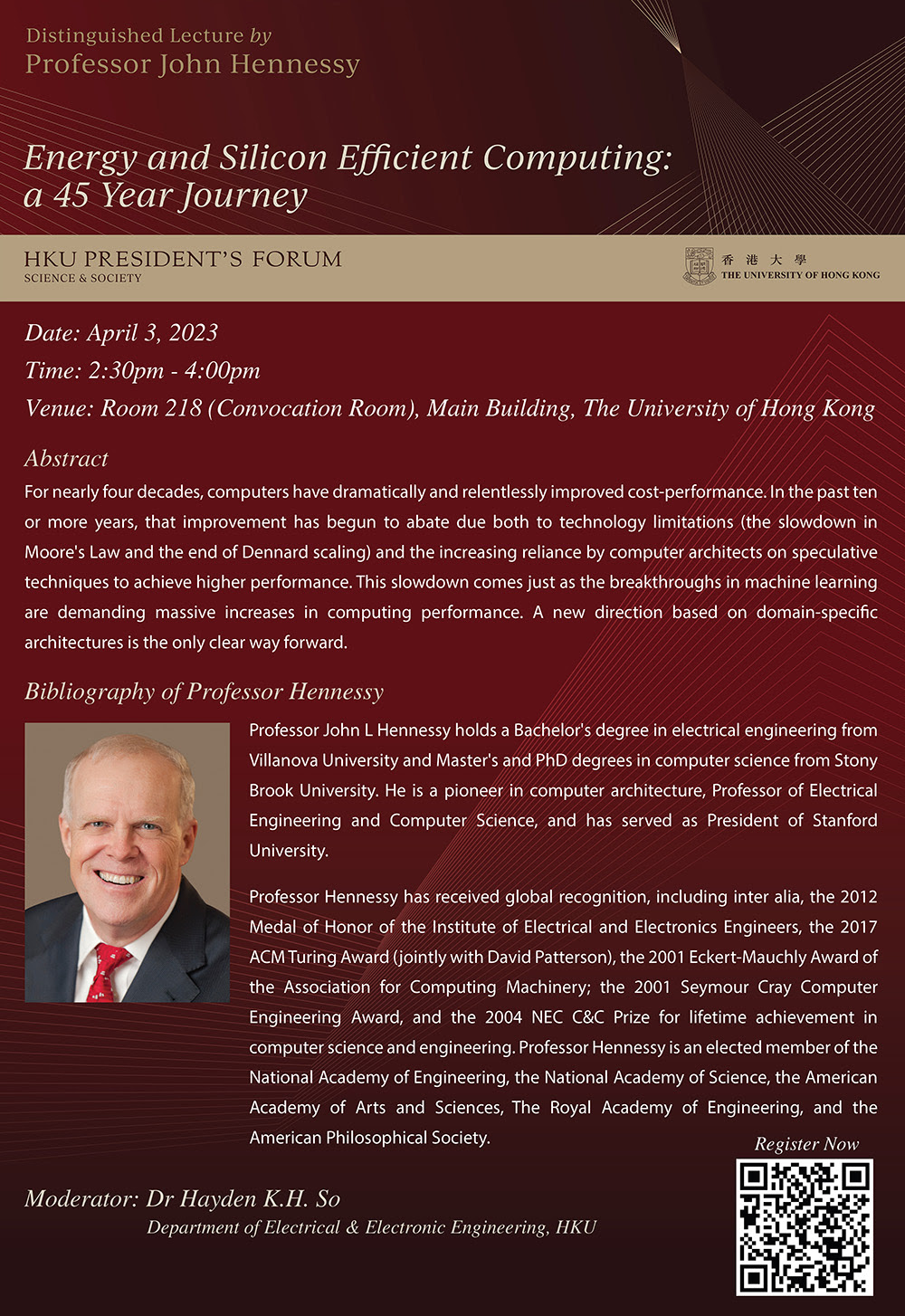 |
HKU President’s Forum – Distinguished Talk by Professor John Hennessy
Topic: Energy and Silicon Efficient Computing: a 45 Year Journey
Time: 2:30p.m. – 4:00p.m. on April 3 (Monday)
Venue: Room 218 (Convocation Room), Main Building, The University of Hong Kong
Audience: around 90-100
Abstract: For nearly four decades, computers have dramatically and relentlessly improved cost-performance. In the past 10+ years, that improvement has begun to abate limitations (the slowdown in Moore's Law and the end of Dennard scaling) and the increasing reliance by computer architects on speculative techniques to achieve higher performance. This slowdown comes just as the breakthroughs in machine learning are demanding massive increases in computing performance. A new direction based on domain-specific architectures is the only clear way forward.
EMS links:
For HKU members (HKU Portal login is required):
For non-HKU members: