
Prof. Yuanwei Liu

Principal Investigator of STAR Open Source LAB@HKU

Professor (tenured), IEEE Fellow, AAIA Fellow, AIIA Fellow, Web of Science Highly Cited Researcher

Department of Electrical and Computer Engineering, The University of Hong Kong.

Vice-Director of Distributed Artificial Intelligence and Digital Twin Lab, Shenzhen Loop Area Institute.

Director of 6G@HKU Consortium.

Vice Director of Low Altitude Economy Research Institute of HKU.

Address: Rm 605, Chow Yei Ching Building, The University of Hong Kong, Pokfulam, Hong Kong.

T: +852 3917 8403

E: yuanwei@hku.hk


Yuanwei Liu has been a (tenured) full Professor in the Department of Electrical and Computer Engineering (ECE) at The University of Hong Kong (HKU)  and a visiting professor in the School of Electronic Engineering and Computer Science at Queen Mary University of London (QMUL)  since September 1st, 2024. Prior to that, he was a Senior Lecturer (Associate Professor) (Aug. 2021- Aug. 2024) and a Lecturer (Assistant Professor) (Sept. 2017- July 2021) at Queen Mary University of London (QMUL), London, U.K, and a Postdoctoral Research Fellow (Sep. 2016- Aug. 2017) at King's College London (KCL), London, U.K. He received the Ph.D. degree from QMUL in 2016. He currently serves as the Editor-in-Chief for IEEE Transactions on Green Communications and Networking (TGCN), and the Chair of IEEE SPCC. He is a Fellow of the IEEE, a Fellow of AAIA, a Fellow of AIIA, a Web of Science Highly Cited Researcher, an IEEE Communication Society Distinguished Lecturer, and an IEEE Vehicular Technology Society Distinguished Lecturer. He was listed as one of [35 Innovators Under 35 China in 2022 by MIT Technology Review], is the recipient of the [2024 Early Career Researcher Award from Queen Mary Research and Innovation],the [2020 IEEE ComSoc Outstanding Young Researcher Award for the Europe, Middle East and Africa Region], the [2020 Early Achievement Award of the IEEE ComSoc - Signal Processing and Computing for Communications (SPCC) Technical Committee], and the recipient of the [2021 IEEE CTTC Early Achievement Awards]. He is the co-recipient of the [2024 IEEE Communications Society Heinrich Hertz Award], the Best Student Paper Award in IEEE VTC2022-Fall, the Best Paper Award in ISWCS 2022, the 2022 IEEE SPCC-TC Best Paper Award, the 2023 IEEE ICCT Best Paper Award, and the 2023 IEEE ISAP Best Emerging Technologies Paper Award. More information can be found in Google Scholar and Linkedin.


  • [HKU OpenSource Lab] Github Page HKU ECE badge, LinkedIn.

  • [OpenAirTwin] GitHub, Website.


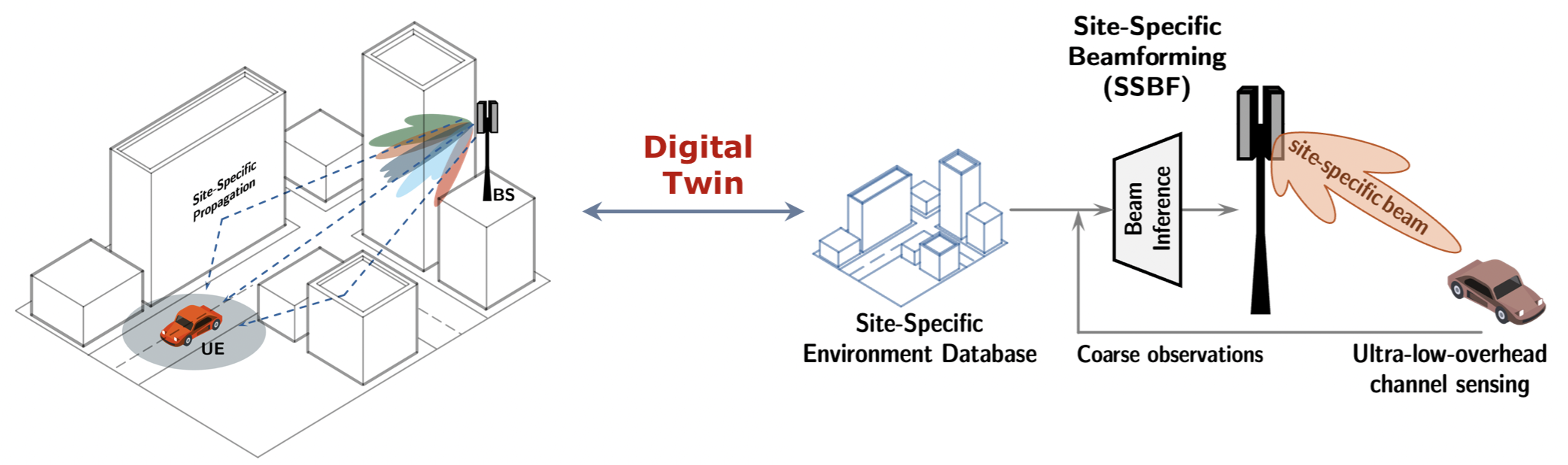
  • [Site-Specific Learning] This research explores the integration of digital twins with machine learning to enable site-specific optimization in wireless networks. By leveraging high-fidelity virtual representations of physical spaces, we develop efficient learning frameworks that significantly improve communication and sensing performance. Unlike conventional machine learning approaches that rely on generalized datasets or statistical channel models for broad applicability, our models exploits the precise spatial and electromagnetic characteristics of a given environment. By prioritizing local accuracy over generic solutions, these digital twin-driven, site-specific models generate highly tailored, robust, and efficient network configurations, bridging the gap between theoretical models and real-world deployment. [Magazine]
    The concept of Site-Specific Learning
    Fig. 1: The concept of Site-Specific Learning.
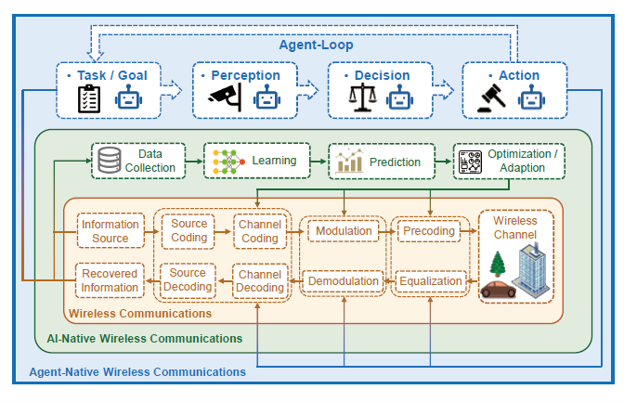
  • [Agent Native Communications] Future wireless communications are moving toward autonomous radio access and service operation, where radio resource control, mobility support, and edge-assisted services need to adapt to time-varying channels and evolving service objectives. To address this shift, this work develops an agent-native wireless communications framework that characterizes the interplay between agent intelligence and communication systems. In this framework, the coupling is organized around agents for communications and communications for agents. For agent-native operation, the architecture combines telecommunication computing, programmable radio access network (RAN) and physical-layer control, and open agent-loop interfaces. Based on this architecture, agents for communications uses agent loops for communication-function design, radio-resource optimization, and action verification, with execution feedback linking network actions to their measured communication effects. On the other side, communications for agents provides loop-aware wireless support for agent-state freshness, radio-edge continuity, and multi-agent coordination, so that agent messages remain valid across radio and edge changes. [Magazine]
    The concept of Site-Specific Learning
    Fig. 2: The concept of Agent Native Communications.
  • [PhD studentships] Multiple PhD studentships of ECE in HKU are availabe here: [The Hong Kong PhD Fellowship Scheme (HKPFS)]; [HKU Presidential PhD Scholar Programme (HKU-PS Programme)].
  • [PhD Admission] I'm always looking for self-motivated students who want to pursue a Ph.D degree in Electrical and Computer Engineering [ECE]. If you are with a solid background in wireless communications/computer science and a strong grounding in mathematical skills, please drop me an email with your CV and draft research proposal. [The Hong Kong PhD Fellowship Scheme (HKPFS)]; [HKU Presidential PhD Scholar Programme (HKU-PS Programme)]
  • Applicants are encouraged to contact me before submitting their applications.

    I also welcome applications for post-doctoral research. I am happy to support your proposal application and hold your position in ECE of HKU.
  • Here are some relevant fellowship schemes which you might apply to [RGC Postdoctoral Fellowship Scheme], [Hong Kong Scholars Program for Mainland, China].